Saturday, 31 March 2012

One Bradford Spring doesn't make a Socialist Summer.

He said that the mainstream parties all told lies, they supported the same wars and the same neo-liberal economics. And he was right.  I just wish it hadn't been Gorgeous George who said it.

I really wish that this was the breakthrough everyone on the Left has been waiting for to seriously challenge Labour in their heartlands. But it isn't. 

What it is - and there's no point in fudging it - is a victory of opportunist communal politics. Not a step forward but a throw-back to the  kind of boss-politics of the US Democratic Party - with whole communities delivered as an ethnic electoral bloc.

I look at Galloway and I see the ghosts of Derek Hatton and Tommy Sheridan at his shoulder. But actually Galloway for all his undeniable charm and guts  represents something far worse - the personality cults of Deza and Tommy may have succumbed to vanity and hubris, but they never so shamelessly politically degenerated into opportunism.
  
Galloway - a Catholic (?) who is happy to play up to the religious sensibilities of his Islamic supporters - says that the extraordinary election result was 'by the grace of god'.  I'm looking at the sad looking pile of TUSC and local anti-cuts alliance leaflets in the corner of my living room - and thinking that building genuine grass-roots resistance isn't quite as spectacular  or miraculous as that .

Thursday, 29 March 2012

In/out - shake it all about

Setting aside the hilarity of the  government squirming over the 'do/don't panic buy petrol' fiasco -  and that 'toffs like pasties too'  fiasco - here's some more overlooked, but equally contradictory news from planet Tory.

Here in Haringey - so very obviously a part of the inner city - Education Secretary Michael Grove has finally woken up to the anomaly that schools here have been receiving per capita funding as if it were an outer London borough. Of course this never made any sense geograhically, sociologoically, economically or culturally  - but there you go.

It might just have something to do with the 'poor performance' of schools here that led Grove to target the borough's schools for academisation - even against the will of staff, parents and governors if necessary. 

Because as with hospitals - or any other public service you can think of  - whilst  funding may not be everything, it doesn't half help. And in that light the decison does represent something of a climb down by Grove - but not I imagine to the extent of withdrawing from his academisation crusade. 

But then again in a classic bit of contradictory  thinking - as they give with one hand comes another suggestion that they take with the other  - and  a ludicrous proposal from the 'riot quango' that schools should actually be fined for not meeting literacy targets

Looks like this fuck-wittery knows no end ...

Monday, 26 March 2012

Told you so.

Usually if you start spouting off about 'the state'  and 'class interests', people's eyes glass over and you're dismissed as a doctrinaire loony. Then every once in a while a story comes along to  remind us exactly of what's what in society - this morning there's two:

Ray's got in there first on The Cruddas Affair - Tory chairman caught red-handed flogging lobbying access to 'Lord Snooty' Cameron himself. The only surprise is that business interests had to pay at all - although presumably big businesses,  like the ones engaged in the Workfare scandal, have their own direct hot-line anyway.

And then there's the news that the army are being trained up to take over from UNITE tanker drivers who have balloted to strike over the bank holiday. Of course the British Army - often smugly seen as superior to the military  in those dodgy countries who dabble in politics -  has a  long and ignoble history of intervening in 'trade disputes' on the side of employers.

Maybe the loonies aren't quite so marginalised after all ...

Saturday, 24 March 2012

A depressing challenge

I observed a history lesson yesterday - Year 11 pupils looking at Nazi Anti-Semitic propaganda from the 1930's. 

This was in a typically diverse London secondary school - with seemingly every ethnicity represented -   except Jewish. 

In my liberal-naivety I thought lessons like that would be tricky because they were shocking and upsetting for the pupils. In fact this one was tricky because may of the kids took the position that given the weight of Nazi propaganda there couldn't (and I quote) 'be all that smoke without some fire'. 

Fucking hell that's depressing. 

The teacher did a valiant job of challenging it: Parallels were drawn with Anti-Semitism then and Islamophobia now. But I'm not sure they were won over. I'd like to think that one day I might do it better. It certainly makes me thing that it's vitally important to try. 

Most of all it makes me think of Christopher Hill's quote which should be carved on the walls of every school:  

‘History, properly taught, can help men to become critical and humane, just as wrongly taught it can turn them into bigots and fanatics.’

Monday, 19 March 2012

Thomas Holmes & the London poor

The Victorians had an obsession for collecting and classification. The rural curate with too much time on his hands scouring the countryside with a butterfly net  is something of a stereotype. And the social do-gooders of the age tended to be all too-similar. 

Henry Mayhew's  definite survey of the London working class is a masterful piece of work - but it is also strangely lacking in affection and human warmth. I don't know about Mayhew specifically, but I suspect that like the naturalists - or the enlightened imperialists of the age of the 'white man's burden' - many of these philanthropists regarded the poor as a different species to be studied, pitied and possibly helped -  but still essentially different.

I've just been re-reading a very different kind of late Victorian social commentary - Thomas Holmes' 'London's Underworld'. By a strange quirk, in the last years of Victoria's reign,  Holmes lived in Tottenham only a couple of streets away from where I am now. Then it was not the  inner city area it is now but a new suburb for the emerging lower middle class - often clerks working in the City. Holmes himself was a crime reporter and perhaps it was this not-quite-respectable job that drew him to the poorer sections of London's working class (and he used 'underworld in the sense of the under-class rather than of a criminal network). He certainly writes about them without the condescension of other do-gooders.

In fact his writing shows genuine affection for the chancers, wide-boys and scammers who would have horrified many who considered such types the 'undeserving poor'. He even has admiration for the ingenuity and invention  of  the con-artists who he was frequently taken in by himself. And far from standing aloof and disapproving from his subjects, he often invited them into his home  maintained friendships with them for years and even lent them money with little hope of repayment.

Most significantly he had no time for the 'self-help' schemes of the moral-improvers and temperance factions - who all wanted to make the under-class respectable. Nor did he have much truck either with philanthropists and charities - including the Salvation Army. In fact in an early glimpse of the welfare state, he argued that all charities should be combined into a single entity run by the government. 

I can't find anything that connects Holmes to the pioneering socialist or labour movements of the time - and he did have some fairly odd ideas about 'incorrigible tramps' and compulsory boarding schools for the bright children of the poor - but he is definitely worth a read.

Saturday, 17 March 2012

Unity still over-due

A year on from my guest piece at 'On This Deity' to mark the anniversary of the Kronstadt Uprising. Also about a year ago I wrote a piece about an over-due rapprochement of the various tribes of the Left.

A year later and another year wiser  - and I think it's truer than ever. 

Last year, in the course of the local anti-cuts campaign, the campaign against workfare and the pensions strikes,  I've campaigned alongside various characters -  Anarchists, SWP,   Labour 'lefts' and former Stalinists  - and been inspired and frustrated in equal measure. And this seemed to have been dependent not upon their historical label or tribal allegiance but on their  individual integrity, decency  and good sense. 

So no apologies for the repetition and re-linking to previous posts. Here's to the future and its possibilities ...

Tuesday, 13 March 2012

The not-so 'real world'

Being around schools these days, an expression I often hear in reference to everything outside education is 'the real world'. And being in a strange sort of betwixt and between position of also freelancing in my old field I am well placed to comapre the two.

Yesterday I had to drop off a job at a typical central London design agency:

Standard layout of offices - a bar and a pool table in reception - smoked glass and minimalism in abundance. I had to meet the production director and the account manager. The production director was a chap about the same age as me who looked as if he had been subject to some sort of queer-eye-for-the-straight-guy make-over by the combined talents of Gok Wan and Jean-Paul Gautier. He looked as if he'd be more at home watching Clarkson with a mug of cocco but felt obliged to dress for work in skinny jeans and one of those scooped fronted tee-shirts to display his slighly portly male cleavage. The account manger was an attractive woman in her thirties dressed fairly normally from the waist up but sporting a pair of skin-tight 1970's hot pants and stilletto shoes. 

For about half an hour they pondered the 'job' I had taken in - a printed mock-up of a magarine tub - with the intensity of two archaeologists examining a precious Ancient Greek artifact - musing wherher or not their concept 'worked'.

Sometimes in schools I  have difficulty keeping a straight face whilst over-hearing teachers ponder if pupils' shoes displaying logos qualify as  trainers and consequently merit a 'leadership detention'. And I wonder if I'm doing the right thing in getting into this world. But then after a glimpse over my shoulder at my former world I am in doubt as to which one is 'real'.

Sunday, 11 March 2012

Catholic home goals again.

Sometimes it's just too easy:

Earlier in the week we had the head of the Catholic church in Scotland talking in a truly staggering example of Orwellian news-speak about gay marriage as 'a violation of human rights'. And then a slightly more tempered bishops' letter read out in all churches in England and Wales condemns the  proposed reforms to  make gay  marriage legal as some sort of an affront to the moral fabric of society.

In between these two self-righteous pronouncements there came the news on Friday that Fr Alexander Bede Walsh was sentenced for 22years for sexual offences against young boys over a twenty year period.

Why any organisation with as dodgy a record as the Roman Catholic wouldn't observe a self-imposed dignified silence on anything remotely connected to human sexuality is a bit of a mystery. But religion and sex have always had a bizarre and fatal connection,  and the Catholics - more than most - just don't seem able to leave it alone.

Sunday, 4 March 2012

Guns (and truncheons) for hire

These days it seems to be a fairly safe bet that if you want to access some dirt on a celebrity, find out the details of trade union activists so they can be black-listed, or even just fancy borrowing a horse for the weekend - all you have to do is 'phone a bent copper.

Even by the usual standards of Tory insensitivity it's pretty staggering that in a week where all these stories are in the news, plans are revealed to put out certain police functions to tendering from private security firms.

Of course dealing with private firms as well as streamlining the whole  business of bribery and corruption will take policing one significant step further away from public scrutiny and accountability. Which I suspect is no accident - it's a process already well-established in the intelligence and security communities where the use of shadowy arms-length private contractors has proved  very convenient in the world of covert and 'dirty' operations.

I can't help recalling that even Machiavlli regarded the dependence of any state for its security on mercenary companies or condottieri was symptomatic of it's moral and political decadence. He had a point.

Friday, 2 March 2012

Changes. Or not.

The more observant of you may have noticed that I have change the 'About Me' on the side panel of this blog. 

It reflects some changes in my life - and I suspect that this might be mirrored with some changes in the subject matter of my posts. There will probably be more about history and education. 

But then again I won't be able to help myself with political posts. And martial arts and bikes remain a big part of my life - so they will continue to creep in too. And 'life and other stuff' has a habit of getting in the way of everything else. 

So maybe no changes at all ...

Wednesday, 29 February 2012

Hypocrisy on health care

How sodding typical of the sinister pomposity of late capitalism that the solution given for the undeniable problems of our beseiged health service is that staff need to be more caring. I predict the introduction of some sort of 'charter', NVQs in compassion and recruitment procedures to test 'emotional intelligence. I have already heard on the radio this morning that customer care lessons are to be taken from John Lewis...and Starbucks.

For five months of last year I watched with anger, frustration and heart-break, my mum die in an acute dementia ward.

The agony of a condition that robs the patient of dignity and of self was compounded at times by what seemed to me like a lack of compassion or respect, and even neglect. But I was also overwhelmed by the kindness and patience of many of the people working in the hospital.

In fact those qualities seemed to be most evident in some of most 'menial' support staff - auxilaries, porters, cleaners etc. The further up the chain of command the more likely it seemed to be that you would find - not  exactly callousness - but a brusqueness and general lack of warmth.

And that's a clue to what should be bleeding obvious. Doctors and nurses were universally stressed and hemmed in by procedures, policies and bureaucracy. And most of all there were never enough of them to take the precious few minutes that constitute 'kindness'.

They don't need charters and courses on caring - they need to know that they have the support and respect of the people who run the health service - and the best way of demonstrating this would be by massively increasing and improving the resources they work with. Not being treated like a failing business to be asset-stripped and flogged off to the highest bidder.

Saturday, 25 February 2012

Workfare sham kicking off

Workfare looks like it's blowing up in Tory faces. 

I've just watched last night's  Newsnight footage. 

In some ways it's a return to the good old 1980's: We've got a Tory arguing the 'commonsense morality' that people shouldn't expect something for nothing. So stacking the shelves in a Tesco distribution centre is the modern version of turning the crank in a Victorian workhouse. Pointless but instilling a work ethic in the otherwise undeserving poor. Countered by a socialist - mistakenly identified as a member of the SWP (why is it they always seem to get the attention of media luvvies?) - arguing that it's all about profit from unpaid labour.

But there's also a thoroughly modern angle too: A nice middle class lad from the Labour Party with a laptop babbling about young people and social media. And best of all a morally bankrupt reptile from brand consultancy Wolff Olins not concerned at all about the morality or politics about young people having to work for benefits - but whether it's good PR for big business to be seen to support the scheme.

Meanwhile in the real world I am just back from leafleting on the issue outside  the local McDonald's - and judging from the response of people who aren't members of Trotskyist organisations, New Labour cyber-activists or brand consultants - it looks like interesting times ahead.

Friday, 24 February 2012

What's in a title ?

Something on the BBC breakfast this morning about the use of Miss / Mrs /Ms. 

It comes in the wake of the campaign in France to replace ‘Mademoiselle’ with a universal ‘Madam’ for all women. Given that ‘Mademoiselle’ translates as ‘little lady’ you can see that you don’t have to be a Feminist to find the title pretty patronising.

And having been filling in more than my share of application forms over the past few moths I have been struck at how odd this obsession with ‘titles’ is. It’s the first question on most forms – yet it’s something that in the normal circumstances no sane person gives much thought to.

Like many things that are dismissed as mere ‘political correctness’, there are actually solid historical grounds for deeming them reactionary and out of place. 

As far as women are concerned the Miss/Mrs/Ms thing is quite straightforward. For centuries to be taken seriously as independent peorson a woman needed a badge of  a man’s endorsement. There were wealthy and influential merchant women even in the Middle Ages – but invariably they were widows. In a later age there was the category of ‘honorary Mrs’ for independent women.  Landladies, housekeepers and cooks were powerful players in the domestic-service hierarchy  - the fictional ‘Mrs Bridges’ of Upstairs Downstairs or ‘Mrs Hudson’ of Sherlock Holmes were not actually married, but required the gravitas bestowed by the title. And in a bizarre twist on the same rationale, lecherous toffs from Charles II to Edward VII would only take married mistresses – even to the extent of finding husbands for the objects of their desire.

When it comes to men, assuming you are not a Duke or Earl, then social implications of titles is a bit more nuanced. In some circles the use of ‘Mr’ is still reserved as a means by which a gentleman can patronize members of the working and. lower-middle class. ‘Mr’ is a tag attached to ‘tradesman’ – a gentleman will refer to his own social equals by a first name, or if he is particularly old-school, by his surname.  In the army it is institutionalised so that the use of ‘Mr’ is reserved for a particular category of senior NCOs’ – a group very much of officers BUT not gentlemen. And if that all seems like archaic pedantry – in the modern world of business the use of first names is just about universal – except as  a subtle way of patronising  builders and other workmen.

So here’s a radical thought – why don’t we just do away with titles altogether? They just perpetuate inequality and provide a crutch for the seriously insecure.

Wednesday, 22 February 2012

Where's the Humanity(ies) ?

A few weeks ago I was delighted to hear that I'd got a place in September to go back to university for teacher training and do a PGCE. And I still am. Although I will be ducking and diving until then, it has given some sort of shape back to me life. However I also was half way through an application for the other sort of teacher training - the learn whilst you earn 'teaching apprenticeship' - the GTP scheme. I'd done what I thought was the hardest part and found a school who would take me on - but I heard yesterday from the university who accredits the scheme that they had been told they would receive no funding this year for Humanities GTPs.

I'm not really in a position to compare the differences in the quality of training between the two schemes. But I do know the financial difference - about £40k. In inner London, that's a salary of £18k for the GTP versus a debt of about the same amount for the PGCE. Fortunately I have redundancy, savings and an understanding family so it won't deter me. But for many 'mature' students the GTP is the only route they can consider.

But setting aside my own money  problems - why the blanket refusal to fund Humanities ?

Supply and demand in the teaching labour market is the easy answer - but in reality there are bigger political issues relating to the curriculum. And the consensus that school should be some sort of pre-training for work shapes this. 

So we are fed  for example a mantra that ICT in schools is an essential part of the country's economic revival. We witness classes full of a generation who have evolved an intuitive grasp of ICT in every aspect of their lives, taught  by older people who struggle with their mobile phones. And they learn on equipment that is more antiquated than anything they will encounter at home or at work. I suspect that for these kids having a distinct subject called ICT makes about as much sense as having a subject called 'eating breathing and sleeping'.

Or there is the dazzling variety of vocational options in supposedly work-orientated subjects. I'm on home ground with these having worked with Modern Apprenticeships for several years: Sadly for the kids who are directed towards them I have to say that they are generally worthless in relation to the practical world of work. Forget graphic arts, media and D&T - the only subject that seemed to have any correlation to trainees' ability in my old world of print and design was good old-fashioned Art.

I know everybody lobbies for their own pet subject - but I can't believe that it is an accident that it is the supposedly 'liberal' arts - the Humanities -  that are getting squeezed out of the curriculum. History more than any other subject encourages you to try to understand the world around you and question what you see. It is consequently the most overtly political of school subjects which is why the Daily Mail et al are so obsessed with the History curriculum as a benchmark of government thinking. 

The UK is the only country where History is not compulsory until school leaving age. And I don't think that it is stretching the point too far to see some correlation between this and our position near the bottom of just about every other index of educational standards. Or the low level of political engagement.

Saturday, 18 February 2012

All the world loves a toff ?

It's a depressing phenomenon that recession seems to go hand in hand with an upsurge of deference. When times are tough maybe it's just easier to look upwards that around you.

This weekend we have the return of the BBC's antidote to ITV's toff-fest Downton Abbey - the revived version of Upstairs Downstairs. The BBC push it even further - their toffs don't just swan about in their big house whilst the rest of the country are up to their necks in shit in the trenches  - theirs' actually flirt with the Mosley and the BUF. But it's OK 'cos you can tell by their fresh complexions, defined cheekbones and vaguely vacant pain-ed expressions that they are just so much more sensitive than the likes of us.

I even see today that there's a new story about Lord Lucan re-surfacing. If ever there was an utterly  pointless and odious toff it was 'Lucky' Lucan - a playboy gambler who did a bunk after killing one of the servants. And had the distinction of coming from a long line of similarly dim-witted morally bankrupt absentee landlords in Ireland - the most famous of which has the dubious distinction of having presided over the charge of The Light Brigade.

What's the fascination ?

Thursday, 16 February 2012

A disappearing name

Being on the cusp of a new life I now find myself having to answer the question - what did you do used to do ? The poncey answer would be 'media-production' - but nobody knows what it means - and it throws up altogether the wrong image of Hoxton-ite wankers. I also have a sense of wanting to capture some industry trivia before it rapidly slips into obsolete obscurity.

I'm inclined to just say that I worked in printing - but just as it did back when I actually was in the industry, that often provokes requests to knock out people's wedding invitations and parish newsletters on the cheap. And I was never that kind of printer.

In fact we would never have used the word printer to describe ourselves. We were 'litho planner/platemakers'. The planning bit has nothing to do with making strategic decisions about the future but comes from the type of printing plate used - which  was flat or planographic.  (A litho plate is flat because lithography relies on the mutual repellence of grease and water to keep the ink where it is meant to be and away from where it isn’t and not a raised or engraved image as in Letterpress or Gravure). If that's confusing - in the 'states the same trade was known as 'film-stripping', which conjures up quite a different image again.

The job of a planner was to get all the elements that make up a piece of print – the photographic images, the illustrations, the text onto a set of four printing plates – one for each  ‘process ‘ colour. And that’s all we did.  We didn’t set type - that was the job of the typesetter. We didn’t lay out the page - that was the job of the paste-up artist. We didn’t proof the page - that was the job of the proofer. And we certainly didn’t print it.  Printers were a different species altogether. If they were feeling particularly precious about it, some of the older guys would refer to themselves as ‘lithographic artists’ or ‘photolithographers’ - but never printers.

Saturday, 11 February 2012

Racism. And class-hatred.

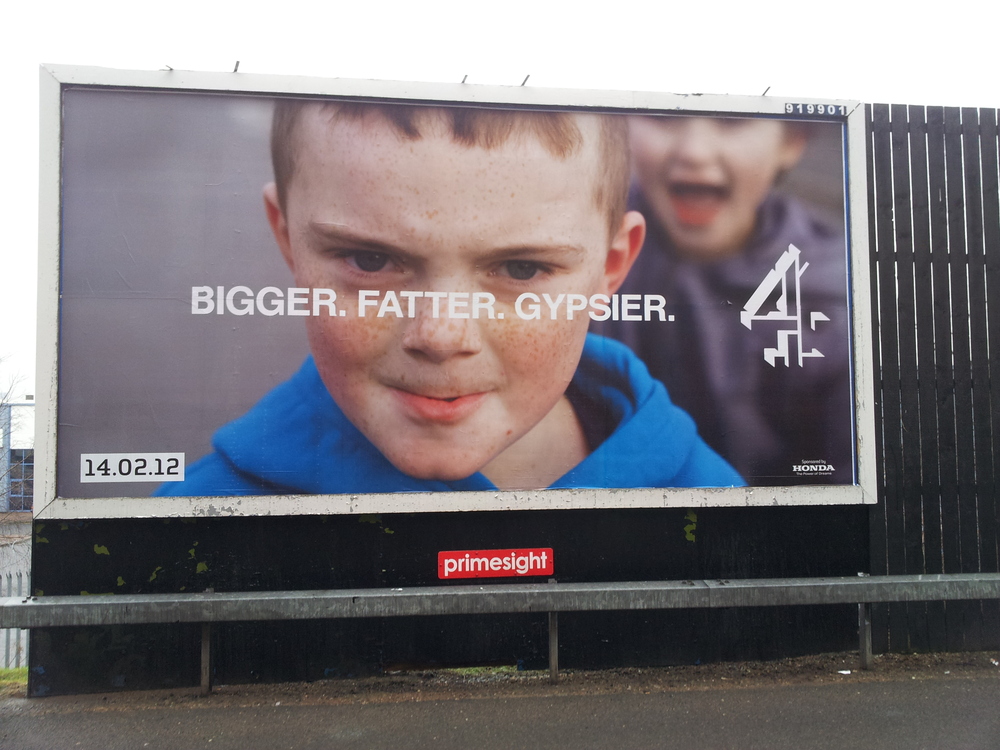
Here we go again: I had to do a dangerous double take whilst riding on my bike when I first saw this poster for the latest Channel 4 series 'inside' the Traveller community - and its even most offensive companion featuring a couple of scantily clad young Traveller women.

I cannot think of any other ethnic group that the media would dare portray in this way. 

Maybe in multi-cultural PC Britain, the closed world of Traveller communities is the only minority left that can be safely sneered at and scape-goated with impunity.

I'd be the first to admit that I know bugger-all about Traveller communities - but I do know snobbery and racism when I see it.

One curious thing  though -  the supposed characteristics of Traveller culture that are pilloried and ridiculed in this program are a sort of caricature of the much broader white working class 'chav' stereotype: More money than taste. Violent. Uneducated. Vulgar. Orange... You get the picture. 

Here's a thought - maybe the media-middle class know they couldn't get away with such a vicious  portrayal of the working class as a whole - so they displace their snobbery on to a smaller group who it's safe to isolate.  Either way it's ugly and leaves a bad taste.

Wednesday, 8 February 2012

Dickens hype

I have a philistine confession to make - I just don't get all the fuss around the Dickens bi-centenary. I have never 'got' Dickens. Sorry. I have tried to  force myself to read a few of his novels because I thought it was a necessary  part of being 'well read'.

I find his style ridiculously verbose - never using one word when twenty five would do; his plot lines ridiculous and convoluted; and as for his characters - they seem to be just a parade of caricatures and stereotypes. But fair enough - that's just my personal taste. I struggle with many of the nineteenth century literary giants. Perhaps it's a reaction to be force fed Thomas Hardy at school A level.

But that's fine; Dickens had an undeniably huge impact although I suspect that rather more people have his fat volumes on their bookshelves, or enjoy the lavish TV serialisations on a Sunday evening, than ever actually read them. Still, on the basis of his undeniably enduring influence, I'll grit my teeth and suffer the excessive fuss this year over his bi-centenary.

But I am forced to spit the dummy when he his held up as some sort of champion of the working class. He may write about the poor with some detail because he knew at times real poverty himself but he does so in a way that sentimentalises 'misfortune' and above all extols the values of self help and respectability. In other words his views are typically those of the Victorian do-gooding middle classes - possibly  well intentioned but judgemental and patronising of their inferiors.

And when the royal family queue up to eulogise him - as they did yesterday - you can be pretty sure that Dickens doesn't belong in the radical pantheon.If you want a slice of social history of the same period with a genuinely  radical edge -  have a look at Zola's Germinal instead.

Friday, 3 February 2012

Goodbye to all that.

Today I am celebrating the anniversary of Gutenburg and the print revolution over at 'On This Deity'.

It's quite a personal piece as it coincides with me finding out this week that I will be starting teacher training - and a whole new life - in September. And leaving the world of printing behind me.

I have been in 'the print' for about twenty five years. Although I followed my dad, and come to that my grandfather too, into the trade, it was not an obvious career choice at the time for a graduate. But I was seduced by the romance and history of printing; a proud and quirky closed world of chapels, banging-out - and journeymen. And the Gutenberg anniversary is an appropriate time to step back and reflect on just what an incredibly important part of western civilisation - and its radical opposition - printing has been for six hundred years.

But Murdoch, technology, corporate avarice  and off-shoring slowly eroded all that romance. And at the same time imperceptibly I slid up the greasy pole into a job far removed from the one I signed up for. To the point that when it all went tits up last Autumn and I was laid off - I felt a sense of liberation.

I'm actually pleased that I am now spending my last few weeks in the print in a small trade house - surrounded by the smell of ink and the sound of endless banter. It's an epitaph for a love affair that is over.

Wednesday, 1 February 2012

Worse than bankers ?

For many years plying my 'honest' trade in the print I thought that I had left my university years a thousand years behind me. Recently, as I have tried to change directions I have had to dig out qualification certificates - even some old essays -  and memories of it have come beck to haunt me. Then this morning thanks to the power of Facebook I saw this message: "Any management consultant alumni out there, please, who could offer some advice to a current student  who is applying for jobs at the moment? Please email XXXX XXX, Deputy Development Director" 

I was tempted to respond.To paraphrase the words of the great late Bill Hick directed at the next circle of corporate hell - marketing: "Kill yourself. Seriously you think I am joking. Kill yourself now. You are Satan's spawn"

Of all the disgusting spectacles that late capitalism throws out there can surely be none worse than that of a pimply pampered young grad eager to advise businesses how to 'downsize and synergize cost efficiencies'.

The equally late and equally great Douglas Adams postulated a future where the useless people - including management consultants - but also estate agents, personnel execs and telephone sanitizers -  were jettisoned from the planet to build a new world on a far away galactic colony. Maybe that's a more humane solution.